Loading…
Post-viral context
COVID and Long COVID
Vilon has not been studied in a published COVID or Long COVID trial. The relevant question is whether thymic aging and immune dysregulation create a biological context where Vilon is worth investigating.
Plausible bridge
Thymus, T cells, and endothelium
01Thymic aging
Thymic aging
An aged thymus exports fewer naive T cells and may struggle to restore immune balance after a severe infection.
02T-cell dysregulation
T-cell dysregulation
Long COVID is associated with altered T-cell subsets, exhaustion markers, and clonal expansions.
03Thromboinflammation
Thromboinflammation
Persistent complement activation and endothelial dysfunction are reported in active Long COVID.
Why the thymus matters
Aging thymic tissue may shape viral recovery
A review article proposed that thymic aging could be associated with COVID-19 pathophysiology, partly because the thymus is responsible for generating the naive T cells that mount novel adaptive responses.
If the thymus is already involuted, the immune system may rely more heavily on memory clones and inflammatory shortcuts, potentially prolonging recovery and increasing tissue damage.
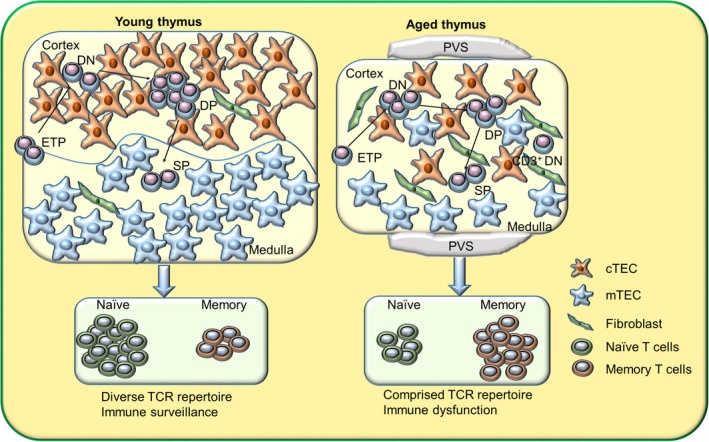
Age-related thymic involution reduces stromal support and naive T-cell output.
T-cell dysregulation
Altered T-cell phenotypes in Long COVID
Studies have reported T-cell dysregulation in Long COVID, including changes in naive and memory subsets and markers of exhaustion. These findings suggest a role for thymic output in restoring balance, but they do not prove that Vilon would help.
Thromboinflammation
Complement and endothelium
A 2024 study found persistent complement dysregulation and thromboinflammation in active Long COVID. Vilon's coagulation-fibrinolysis data are too limited to draw a clinical link, but they sit in the same biological neighborhood.
Research question
Could Vilon matter in post-viral recovery?
The honest answer is unknown. Vilon has immune and coagulation-fibrinolysis plausibility, but it has not been tested in a post-viral human population. Any use should be framed as an experimental question, not a treatment.