Loading…
Identity
What is Vilon?
Vilon is Lys-Glu, the KE short-peptide component in the Thymalin literature.
Vilon
KE
Thymalin is a peptide complex, not a single longer peptide; Vilon is associated with that broader complex in the literature.
- Sequence
- Lys-Glu
- Formula
- C11H21N3O5
- Molar mass
- 275.30 g/mol
- PubChem CID
- 7010502
Probable Mechanisms
Vilon has been studied in cultures of thymocytes and splenocytes, where it modulates markers of proliferation and apoptosis. These studies describe immunomodulation rather than direct FOXN1 activation.
Older work with related thymus peptides (T-38/KED) shows cortical thymocyte effects, but that compound is Glu-Asp-Lys, not Lys-Glu.
Missing experiment
The FOXN1 assay has not been published
If Vilon really rebuilds the thymic microenvironment, FOXN1 is where we would look first. The direct experiment, a controlled measurement of Vilon on FOXN1 expression, chromatin accessibility, or TEC identity in a relevant model, has not been done.
Until that work exists, Vilon should be treated as a peptide with immune and gene-regulatory plausibility, not as a FOXN1 activator.
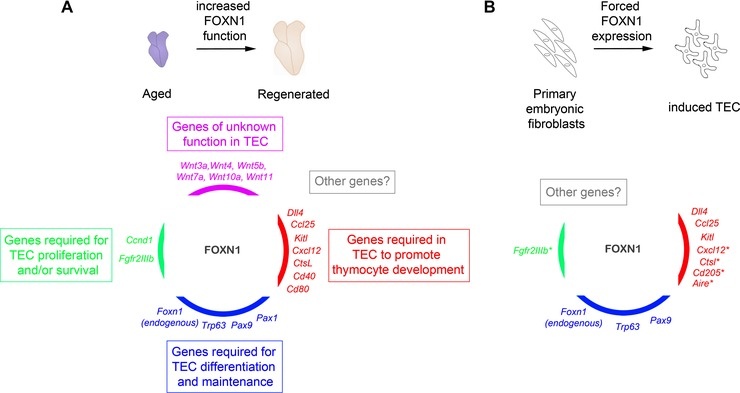
FOXN1 functions as a transcriptional regulator of thymic epithelial identity and is linked to regeneration programs.
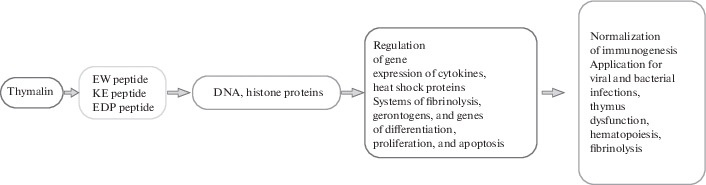
Short thymic peptides are described in review literature as modulating immune and gene-regulatory pathways.
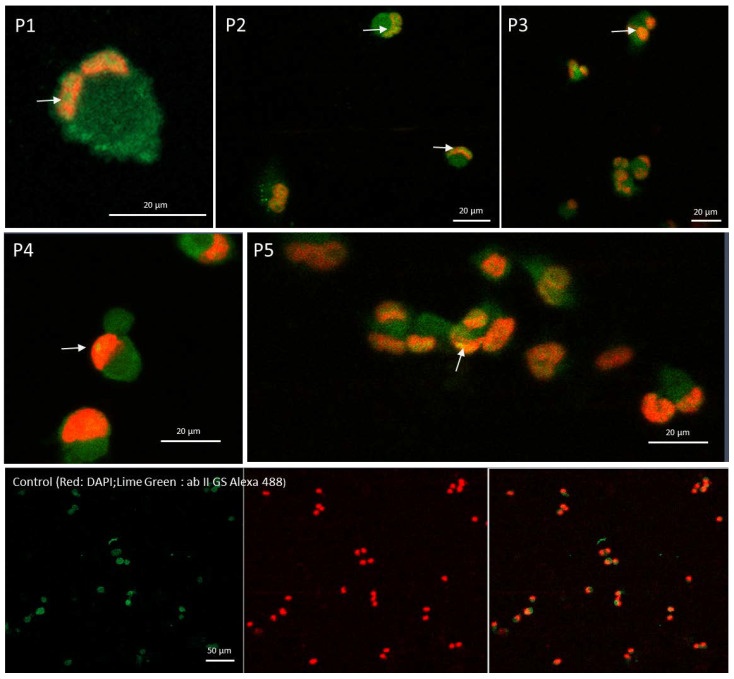
In THP-1 macrophages, Vilon was associated with changes in STAT1 localization. This is a monocyte model, not a thymus outcome.