Loading…
Structure
Chemistry
Vilon is nothing more than lysine and glutamate joined by a single peptide bond. Its size is what makes it both interesting and uncertain.
Loading molecule…
Use the selector to switch between spacefill, stick-with-hydrogens, and 2D structural formula. Drag to rotate.
Lys-Glu
KE
Lysine
Lys
C6H14N2O2
Glutamate
Glu
C5H9NO4
Dipeptide
C11H21N3O5
275.30 g/mol
From amino acids to transport
Lys-Glu as a dipeptide
01Lysine
Lysine
Lysine is a basic amino acid with a long side chain. Its formula is C₆H₁₄N₂O₂ and it carries a positive charge at physiological pH.
02Peptide bond
Peptide bond
Lysine and glutamate are joined by a peptide bond between the carboxyl group of lysine and the amino group of glutamate.
03PEPT1 transport
PEPT1 transport
As a dipeptide, Lys-Glu is a candidate substrate for the PEPT1 intestinal transporter.
Chromatin and DNA
Could a dipeptide reach chromatin?
The Khavinson group has argued that short peptides can regulate gene expression, with KE proposed to interact with DNA motifs such as TCGA. A 2021 review summarized these claims and included a modeled interaction of the KE dipeptide with a DNA binding motif.
This is modeling and review-level evidence, not a demonstrated in vivo mechanism for FOXN1 or the thymus. If Vilon acts at the gene level, the target and dose-response remain unknown.
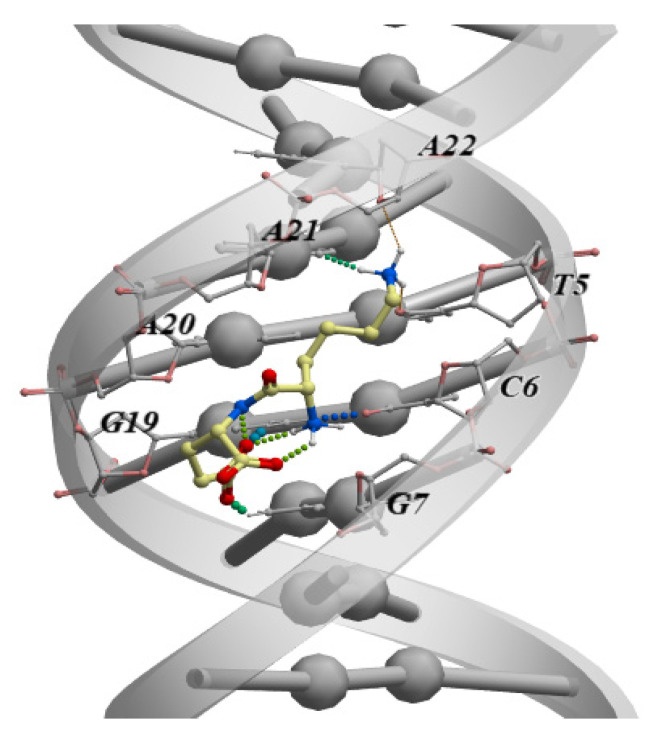
Molecular modeling figure proposing KE interaction with a DNA binding motif. This supports plausibility, not proof.
IL-2
Vilon has been reported to alter IL-2 gene expression in splenocytes. This links the peptide to T-cell signaling but does not prove thymic regeneration.
SIRT1
A 2023 report described KE regulation of SIRT1, PARP1, and PARP2 in aging mesenchymal stromal cells. This is a cell culture aging model, not a thymus assay.
PARP
PARP enzymes are involved in DNA repair and chromatin remodeling. Changes in PARP activity could in theory influence gene accessibility, but the relevance to FOXN1 is speculative.
Missing experiment
The FOXN1 question is still open
If Vilon really rebuilds the thymic microenvironment, FOXN1 is where we would look first. The direct experiment has not been done.